
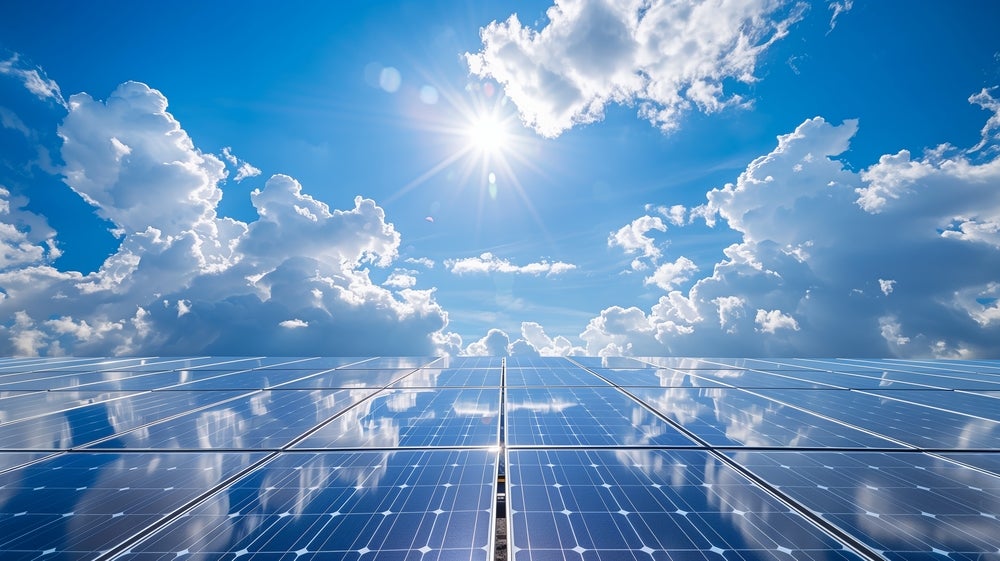
When Markéta Šindlerová talks about solar panels, she doesn’t start with sunlight or temperature – she starts with data. “The point of EmissionBase,” she says, “is to know how much CO₂ is produced in each life-cycle phase: production, operation, and end of life.”
A PhD candidate at the VSB–Technical University of Ostrava, Šindlerová has spent the past year at STH Consulting as Lead Researcher, building emissions models for EmissionBase, a CO₂ database for asset finance companies created by CEO Petr Thiel. Until recently, her work focused on construction machinery and agricultural equipment, sectors where emissions accounting follows predictable fuel-use and fuel-burning patterns. “Renewable assets are different,” she says. “They reduce emissions during their use-phase. So we agreed this category needed deeper research.”
Go deeper with GlobalData


Access deeper industry intelligence
Experience unmatched clarity with a single platform that combines unique data, AI, and human expertise.
That decision led to a collaboration between STH Consulting and the VSB-Technical University of Ostrava, resulting in the September 2025 study, Assessing the Environmental Impacts of Renewable Energy Sources: A Life Cycle Perspective Using Solar Panel Models and Case Studies. The project aims to fill a critical gap in emissions data for renewable infrastructure, information now essential for banks and leasing firms pricing carbon risk into their portfolios.
Šindlerová’s team began with the technology best supported by reliable data: solar panels. “To open the renewable energy chapter of our research, we started with solar power – the field with the most consistent and well-documented lifecycle data,” she says. The study draws on Environmental Product Declarations (EPDs), publicly available certificates that quantify a product’s environmental footprint. Each EPD corresponds to a specific model and includes values for production, operation, and recycling. The first challenge? “The data came in different units,” she explains, “so we had to harmonise it before we could even start comparing results.”
To make the analysis practical for financiers, the team used a single, widely accepted metric, Global Warming Potential (GWP), expressed in kilograms of CO₂ equivalent. “We didn’t include water use or resource depletion,” Šindlerová says. “GWP is the language of ESG and green finance, it lets everyone speak the same carbon language.”
The result was a harmonised dataset of ten solar panel models, enabling the researchers to map the full life-cycle footprint from raw materials to recycling. The study’s key finding: solar panels recover their entire carbon and energy investment in roughly two years of operation.
US Tariffs are shifting - will you react or anticipate?
Don’t let policy changes catch you off guard. Stay proactive with real-time data and expert analysis.
By GlobalDataAlmost all emissions occur before the first kilowatt-hour is generated, with manufacturing, from material extraction to assembly, responsible for the vast majority of the footprint. Transport and installation add comparatively little, and once installed, panels run virtually emission-free.
“After that two-year payback, the product delivers only net environmental benefits for the remainder of its 25-year lifespan,” Šindlerová says. “We believe our findings are realistic – they align closely with other studies showing a range of 1.8 to 2.5 years.”
At end-of-life, recycling and material recovery bring further gains, as reclaimed glass, aluminium, and silicon more than offset the impacts of disposal.
Significantly, the dataset now underpins EmissionBase’s renewable energy module, a tool designed to make lifecycle CO₂ data accessible for those financing the energy transition.
Šindlerová believes the framework will evolve alongside the technology. “The principles stay the same,” she says. “We can update the numbers as new photovoltaic models appear and see how the carbon footprint improves over time.”
It’s an engineer’s answer, practical, data-driven, and open-ended, but it also marks a shift in how clean energy is valued: not just by what it produces, but by the emissions it avoids, and by the transparency with which that balance can now be measured.
Read or download the full report below: