As Geotab marks 25 years at the heart of the connected-vehicle revolution, founder and CEO Neil Cawse reflects on cloud resilience, OEM collaboration, and why the future of mobility depends on data more than ever.
The connected vehicle is no longer just a data node in a fleet, it’s a data ecosystem on wheels. Behind that transformation sits a handful of companies building the invisible infrastructure that keeps it all moving. One of them is Geotab.

Access deeper industry intelligence
Experience unmatched clarity with a single platform that combines unique data, AI, and human expertise.
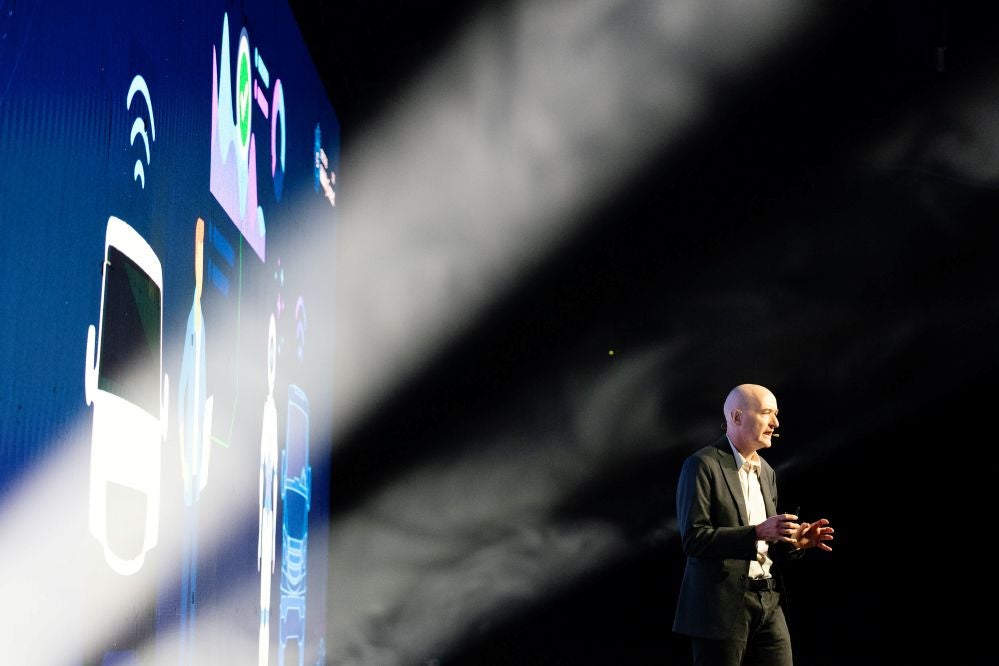
At its Mobility Connect 2025 conference in Luxembourg this month the company gathered Europe’s connected-vehicle community to reflect on how far the software-defined car has come, and how much of its future will depend on the integrity of the data that fuels it.
On the eve of the event, Geotab announced the acquisition of Verizon Connect’s commercial telematics operations in key international markets, including the UK, France, Germany, and Australia, a deal that underscored an acceleration, rather than a consolidation, of its global strategy.
Throughout the conference agenda, two mantras echoed in the sessions and panel discussions: “The future is being driven by data,” and “Data is the food of AI.” Both would resurface during my discussion with Neil Cawse, Geotab’s founder and CEO.
And while the conference had all the polish of a corporate milestone, there was also something disarmingly grounded about meeting Cawse face-to-face, an engineer by training and an entrepreneur by necessity, who would rather discuss the nuances of ingress and egress charges than bask in boardroom platitudes.
US Tariffs are shifting - will you react or anticipate?
Don’t let policy changes catch you off guard. Stay proactive with real-time data and expert analysis.
By GlobalDataFrom Johannesburg to Oakville
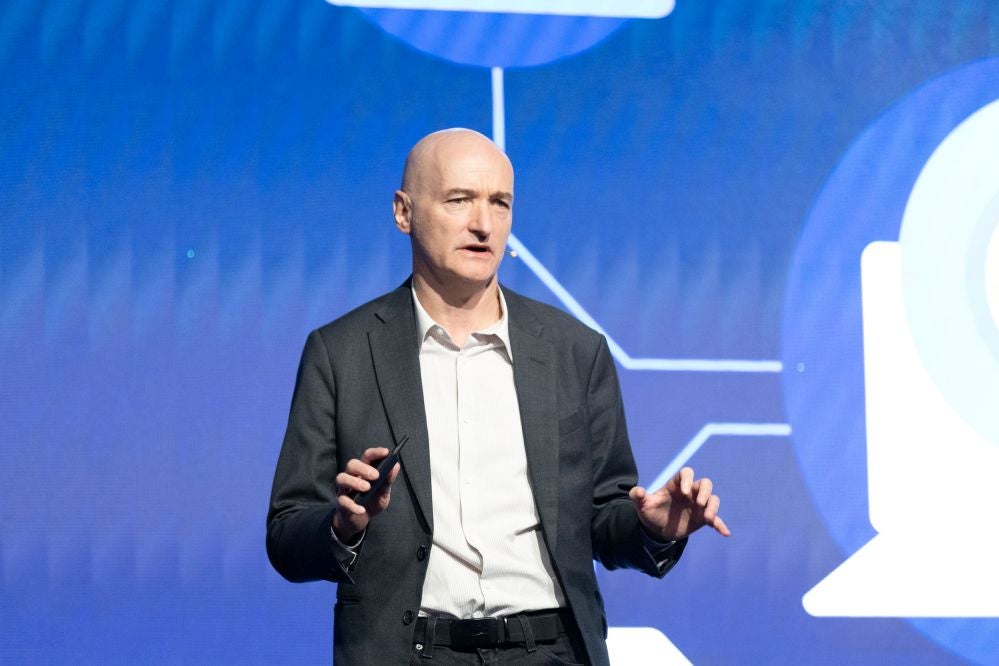
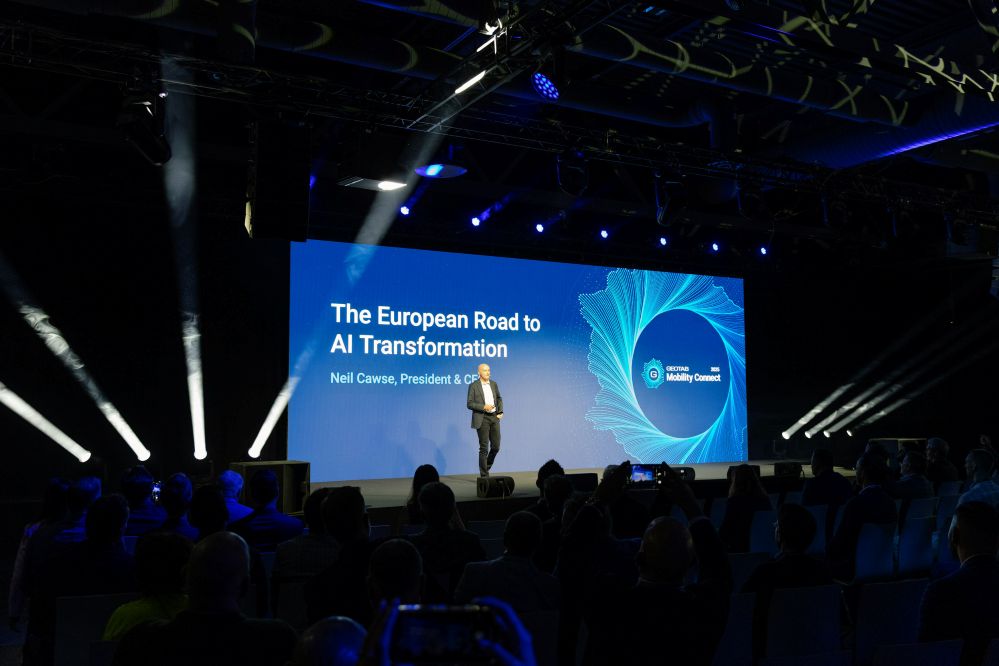
Like Elon Musk, Cawse was born and raised in South Africa, but, as he put it, “that’s where the similarities end.” After earning a BSc in Electrical Engineering from the University of the Witwatersrand, he co-founded a software company in Johannesburg whose code was used in South Africa’s historic 1994 democratic election.
After selling that business, he relocated to Canada and, in 2000, founded Geotab in Oakville, Ontario. What began as a modest telematics start-up has grown into a global enterprise with 2,700 employees, more than 55,000 customers, and an ecosystem of over 700 partners spanning the connected-vehicle value chain.
The company’s success rests on a deceptively simple piece of hardware: the Geotab GO device. Installed in more than five million vehicles, the GO captures granular data on location, speed, idling, fuel use, and a host of engine diagnostics. But it’s what Geotab does with that data, how it analyses, standardises, and translates it into actionable insights, that has made it indispensable to fleets and OEMs alike.
Cloud resilience and the price of freedom
A week before Mobility Connect, the fragility of our cloud-dependent world was on display when Amazon Web Services (AWS) suffered a major outage, briefly halting operations for retailers, banks, and streaming platforms.
So, naturally, I asked Cawse whether Geotab had been affected. “Yes, that’s a good question,” he said, leaning forward slightly. “The issue was with DynamoDB, a part of AWS that even affected companies like Netflix. But we weren’t impacted. Our primary cloud provider is Google Cloud Platform. We use AWS too, but we’ve always believed in a multi-cloud strategy for exactly this reason, resilience.”
He paused. “Ten or fifteen years ago, if telematics went down, it wasn’t the end of the world. You could fix it by the next day. Today, everything runs through the cloud; uptime, reliability, and security are non-negotiable.”
That kind of resilience doesn’t come cheap. Running multiple clouds means duplicating data across providers, a strategy that drives up storage and transfer costs when you’re handling billions of transactions a day. Cawse doesn’t shy away from the trade-off. “Multi-cloud comes at a cost, but the alternative is worse,” he said plainly.
Running multiple clouds means duplicating data and paying steep ingress and egress fees, charges for moving data in and out of a provider’s infrastructure. “Those have always felt manipulative,” Cawse admitted. “It’s about creating vendor lock-in. The good news is the industry pushed back, and we’ve seen reductions or waivers. But the risk of cloud concentration remains. The last thing any of us wants is a monopoly.”
For Geotab, the payoff is independence, the ability to switch infrastructure, shift workloads, and maintain uptime across regions. “Technology changes fast. Geopolitics changes fast,” Cawse said.
Keeping its options open is part of Geotab’s resilience plan, he said.
AI: Between hype and reality
If data is the food of AI, then Geotab sits somewhere between the kitchen and the dining table. Its analytics engines feed thousands of machine learning models that power everything from predictive maintenance to route optimisation and carbon accounting.
With much of the discussion at the Luxembourg conference revolving around the potential of artificial intelligence in fleet management, predictive maintenance, and sustainability, I had to ask about the Bank of England’s recent warning that AI equity valuations look stretched and that a market correction could be coming. Did Cawse think a bubble was forming?
He didn’t hesitate. The real hype, he said, tends to live in the world of public companies, those with shareholders to satisfy and vast marketing departments, rather than in privately held firms like Geotab. “But we see the hype around us,” he acknowledged. “There’s an incredible amount of overspending globally on AI infrastructure, on energy, on data centres, and on hardware. If you take ten companies, one might knock it out of the park. The other nine will probably struggle.”
“But none of this means AI isn’t real. It’s absolutely transformative. AI is both overhyped and underhyped – and that’s what makes it exciting.”
For Cawse, the hype also masks a deeper truth: AI’s democratising potential. “Look at open-weight models,” he said. “Eighteen months ago, the best model in the world was closed and cost hundreds of millions to train. Today, you can run something comparable on a laptop. That’s huge. It levels the playing field.”
Open-weight models (those whose trained parameters are publicly available) are allowing smaller firms, researchers, and even individuals to build competitive AI systems without needing the financial muscle of the tech giants. “It’s democratising,” Cawse said. “It levels the playing field. That’s the kind of revolution we like – it fits with how the internet was supposed to work.”
He smiled. “The one-person unicorn company is now a real possibility. That’s what excites me.”
Standardisation, harmonisation, and ownership
If there was one notable source of tension at the conference, it was between OEMs and data aggregators, and the question of who owns, cleans, and standardises vehicle data.
During a lively panel featuring Ford, BMW Group, and Volkswagen, several OEM representatives pushed back at the idea of being required to provide industry-standardised data outputs from their vehicles, calling such efforts “stifling to innovation.”
Cawse acknowledged their position but argued for pragmatism. “The future of telematics doesn’t belong to a device,” he told me. “We don’t want another piece of hardware in the vehicle when we can get high-quality data directly from the OEM. But the challenge is consistency. If one OEM sends updates every five minutes and another every second, how do we harmonise that?”
That’s where COVESA, the Connected Vehicle Systems Alliance, enters the story. “We’ve donated technology to COVESA so OEM data can be standardised,” Cawse said. “It’ll take time, maybe a few more years, but it’s moving in the right direction.”
Geotab has been on this journey for seven years, and the progress is tangible. “The OEM servers are more stable, the data streams more reliable,” he said. “But we’re not there yet.”
And who, ultimately, owns the data? “That’s nuanced,” he said. “Where I drive, when I drive, speaking as an individual, that’s mine. Proprietary algorithm data about, say, a turbocharger’s heat distribution – that’s the OEM’s. But in between, there’s shared data. Brake system health data, for instance, benefits both the driver and the manufacturer. The key is to separate these layers intelligently.”
In practice, that means co-development rather than competition. “We’ve helped OEMs think differently about data,” he said. “Most now see the value in partnership. We work with over 80% of OEMs globally – that trust has taken years to build.”
China, BYD, and the politics of access
No conversation about global mobility is complete without mentioning China. “In China, every vehicle’s data goes straight to central servers,” Cawse explained. “Foreign companies can’t run telematics operations there without a local licence – and that requires Chinese ownership. So we can’t operate directly inside China.”
Instead, Geotab has built an alliance with BYD, China’s fast-rising EV giant. “When a BYD truck is sold in Europe or Latin America, the onboard telematics module is replaced with a Geotab GO device,” Cawse said. “It’s a healthy partnership, customers know their data’s handled by a trusted third party.”
He’s unabashedly impressed by BYD’s pace. “I toured one of their battery plants, a kilometre and a half long. The scale was mind-blowing, and as an engineer I love to geek-out on that stuff. They’ve taken decades of manufacturing know-how from the West and scaled it to an extraordinary level.”
Still, he can’t hide a note of frustration. “We’re opening Europe to Chinese automakers, but Western telematics companies can’t work freely in China. There has to be some quid pro quo.”
Measuring impact in lives, not metrics
Cawse remains allergic to hyperbole, but his mission has moral weight. “The data we gather isn’t abstract,” he told me. “It saves lives. Telematics can cut fleet accident rates by up to 40%. Statistically, one in every 400 road accidents ends in a fatality. Reduce accidents, and you save lives. There’s no T-shirt that says ‘Saved by Geotab,’ but that’s what’s happening.”
For Cawse, the impact of technology isn’t found in hype surrounding algorithms, but in tangible human outcomes. “That’s what keeps me going,” he said. “Knowing that data – used right – can make roads safer, fleets greener, and businesses smarter.”
Geotab expands Europe & Australia sales with Verizon deal
Geotab and Vitality launch JV focused on driver safety and behaviour