



Parents – often a trusted source of advice[ii] – are also more optimistic about the experience and qualifications provided by apprenticeships, as well as their cost-effectiveness.[iii] This certainly wasn’t the case when I joined the workforce!
However, it may take some time until we see this reflected in the numbers. Young people still need more thorough career advice, so they can understand the full range of pathways available to them.[iv] Finding opportunities can be surprisingly difficult too.[v]
And while businesses recognise the value and need for apprenticeships, they report “limited internal capacity for training, funding constraints, and administrative complexity”[vi] as barriers to offering more apprenticeships roles. Ongoing changes to government policy have also left some concerned about future pivots.[vii]
What is clear is that we need to maintain momentum in the years ahead. Those who are curious about apprenticeships need clear, accessible advice to make informed decisions, and businesses need the right incentives to offer more opportunities.
Closer to home, in financial services, employers see apprenticeships as a valuable solution to fill skills gaps and ease recruitment challenges.[viii] However, many in the sector would welcome closer collaboration between government, employers and professional bodies both to raise awareness among candidates and to ensure programmes deliver training that genuinely reflects industry needs.[ix]
The UK’s apprenticeship landscape: Facts & figures
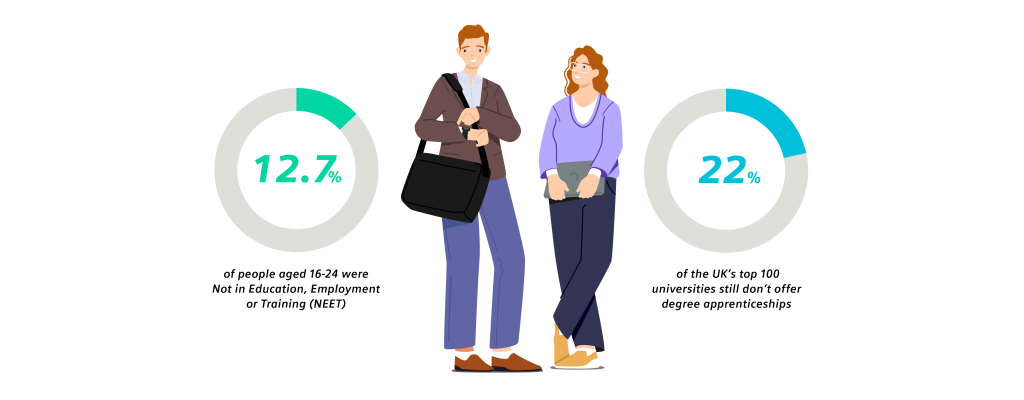
Between July to September 2025, 946,000 people aged 16-24 were Not in Education, Employment or Training (NEET), equivalent to 12.7% of all people in this age group.[x] This is up from around 800,000 in 2019.[xi]
Apprenticeships can help to address this growing concern. Their economic value is immense too. In England alone, apprenticeships are expected to contribute £25 billion to the economy, nearly double the £14 billion estimated in 2018.[xii]
Yet despite the clear benefits, demand far exceeds supply. The government’s apprenticeship matching scheme routinely receives three times more applicants than there are available placements.[xiii] Did you know apprenticeship provision for young people – as an alternative to A-levels – has halved over the past decade?[xiv] Meanwhile, 22% of the UK’s top 100 universities still don’t offer degree apprenticeships.[xv]
To help address this shortfall, the government announced a £725 million package of reforms to the apprenticeship system in December 2025.[xvi] As well creating 50,000 more placements, the package will also now cover the full cost of apprenticeships for eligible young people under 25 at small and medium-sized businesses, easing the burden for these businesses.
Apart from the supply-demand gap, another concern is the length and depth of apprenticeship programmes. In countries such as Germany, Switzerland or Norway, apprenticeships last at least three years; in England, the average duration is just 15 months.[xvii] Off-the-job training hours are also comparatively low[xviii]; other countries often mandate a significantly more robust academic component.

Early career pathways at Siemens
Our Early Careers programmes at Siemens Financial Services (SFS) are designed to help employees make the leap from education to employment, equipping them with the tools they need to thrive – from day one. These programmes aim to deliver immersive experiences, personal development, and a strong sense of community.
Today, our Early Careers offering spans three dynamic pathways:
- Apprenticeships – For school leavers and career changers, combining work experience with formal qualifications
- Graduate schemes – For university leavers seeking rotational experience across multiple business areas
- Internships – For students looking for short-term projects and real industry exposure (i.e. 3 month summer or one year university placement)
“Early Careers isn’t just about filling roles – it’s about creating a culture where young professionals thrive, innovate, and feel seen. We give them the tools, exposure, and confidence to shape their own future.
“Based on my own experience of entering the workplace for the first time, I know the world of work can feel daunting, so I aim to create a great initial experience—equipping them with the support to grow and develop to their full potential.
“I love encouraging our Early Careers Professionals to build their own community – socialise, innovate, push boundaries, and take the initiative to develop strong working relationships. I’m particularly proud of introducing our popular ‘Ask Us Anything’ sessions with our Senior Leadership Team, where both sides learn so much from one another.
“In my work, I design programmes that help young talent discover their strengths, build confidence, and start their careers strong—while shaping inclusive, growth-focused environments where creativity flows and diverse voices are celebrated.”

Introducing the SFS sales apprenticeship
In December 2025, the Sales team at SFS welcomed its first apprentice – building on the apprenticeship initiatives already established across the organisation.. This is a three-year programme, providing a qualification equivalent to an undergraduate degree. I worked with our talent and culture expert to develop a programme with a clear set of goals.

Our Sales apprentice will be learning the full spectrum of sales skills – from how to manage customers, all the way to developing customer strategies. He also has his own customers to look after, so that he can put these lessons into practice and be held accountable. He’s already adding value to the business – he was particularly engaged and able to contribute a fresh perspective during our recent AI workshop, for instance. The steep learning curve starts on day one.
Sales lends itself very well to an apprenticeship, given that it is people focused. It’s a rewarding, and potentially well-paying field, and yet most of my team accidentally fell into their roles. This is because we need earlier awareness of the breadth of roles and industries out there, so that young people can more easily pursue jobs that best fit their skill sets. Whilst Sales isn’t for everyone, it is at the heart of every business and demands both commercial understanding and excellent people skills – I’d love to see this sector get the recognition and respect it deserves.
Debunking apprenticeship myths
Though there is greater awareness of the benefits of an apprenticeship, stigma can still sometimes get in the way of people taking this route.[xix] Addressing misconceptions is key to enhancing the accessibility and take-up of apprenticeships. Here are a few common myths versus the real-world outcomes from SFS’ apprenticeship programme.
- MYTH: “Apprenticeships aren’t as valuable as degrees”.
REALITY: Apprenticeships offer qualifications and paid experience.
At SFS, apprentices ‘earn and learn’, receiving a salary while working towards a qualification. Among our programmes are a two-year Apprenticeship in Business Administration and our three-year Degree Apprenticeship in B2B Sales, both of which support candidates’ chances of gaining full time employment. Study time is built into the schedule to support a healthy work-life balance.
In addition to the qualifications they earn, our Early Careers cohorts all benefit from on-the-job integration into the workplace including extra-curricular activities such as:
- Five paid volunteering days – Giving back while building leadership skills
- Challenges & tasks – Designed to stretch skills and encourage creativity
- Leadership access – ‘Ask Us Anything’ sessions with the C-suite for strategic insights and personal stories and relationship-building opportunities
- Mentoring & networking – Regular mentoring and peer-to-peer support to accelerate growth
- MYTH: “Apprentices don’t do ‘real’ jobs, they only do admin”.
REALITY: SFS apprentices contribute from day one.
SFS apprentices lead and support on meaningful projects early in their journey. Part of being an apprentice at Siemens Financial Services means you get to work on real life projects whilst also being supported through guided learning. For future employers, hiring an apprentice who already has this commercial experience and workplace maturity is a huge advantage.
- MYTH: “Apprenticeships are only for vocational industries”.
REALITY: Opportunities span diverse industries.
Today, apprenticeships are available in perhaps unexpected fields (see my sales example above). These include business, marketing, chemistry, journalism and even professional sports. The SFS programme exemplifies this, providing a diverse and holistic experience of how a major corporate business operates. Apprentices can also rotate across departments – Risk, Asset Management, Collections, Business Processing, Operations Support and Customer Services.
In Year 1 of the Business Administration apprenticeship, apprentices rotate across teams over eight months while pursuing a Level 3 Diploma. In Year 2, they continue rotating while preparing for their End Point Assessment – the final step to earning their qualification.
“The fact that with this apprenticeship you get to try out different roles and meet people from each department is really refreshing. It means you learn things that people who work solely in one area wouldn’t know. I think I’m better at understanding my area because of my time and learnings in other departments.”
Apprentice at Siemens Financial Services UK

- MYTH: “Apprenticeships don’t lead to careers”.
REALITY: Apprenticeships are a direct path to long-term employment.
Carl Ennis, CEO of Siemens Great Britain and Ireland, began his journey as an apprentice. “…education at 16 was not for me, and I took an apprenticeship route, but then was very lucky to have a supportive employer who helped fund me through further education ultimately, through my degree…I was able to balance this real-world experience with the education I’d gained to position myself…”[xx]
Apprenticeships provide a springboard into industry. At SFS, this is backed by strong mentoring, dedicated support and structured development – making our apprentices real assets in the workplace.
And the national statistics speak volumes: 85% of apprentices stay in employment after completing their programme, and 64% remain with the employer where they trained.[xxi] At SFS, many apprentices choose to stay on. Far from being a side route, apprenticeships can pave the way to senior leadership roles.
A level playing field
As the UK grapples with a widening skills gap and an evolving economy, Early Careers programmes offer a solution that benefits everyone: young people gain hands-on experience and recognised qualifications without the burden of student debt, while employers nurture future talent tailored to their business needs.
Offering multiple pathways to the workplace, and treating each one with equal respect, levels the playing field and ensures that there are opportunities for every individual – not only those who are academically inclined. It may also help to ensure that those who do take the university route are truly committed and have wholeheartedly chosen this route after reviewing the full range of options.

SFS stands at the forefront of this approach. Our people are our USP so we continue to review and refresh how we nurture and encourage talent. We firmly believe our thoughtfully designed programmes, robust mentorship and real-world opportunities create future leaders.
Early Careers talent brings fresh perspectives, cultural diversity and digital fluency – qualities that drive innovation and help us stay competitive in a rapidly changing financial landscape. By investing in these schemes, SFS is shaping careers – and the future of financial services.
Learn about Early Careers opportunities with Siemens Financial Services here.
[i] See, for instance, Prospect Luminate, A-level students on careers advice, AI anxiety and alternative pathways, August 2025 https://luminate.prospects.ac.uk/a-level-students-on-careers-advice-ai-anxiety-and-alternative-pathways
[ii] See, for instance, Advance, Two-thirds of parents back apprenticeships as first choice after school, 9 February 2026 https://www.adsadvance.co.uk/two-thirds-of-parents-back-apprenticeships-as-first-choice-after-school.html
[iii] ibid
[iv] The Manufacturer, Report reveals a lack of awareness and poor career advice is impacting apprenticeship uptake, 11 Feb 2026 https://www.themanufacturer.com/articles/report-reveals-a-lack-of-awareness-and-poor-career-advice-is-impacting-apprenticeship-uptake/
[v] FE Week, Landing apprenticeships is easier said than done for young people, 18 Sep 2025 https://feweek.co.uk/landing-apprenticeships-is-easier-said-than-done-for-young-people/
[vi] Grant Thornton, Apprenticeships increase in popularity with employers, but uncertainty, capacity and policy hold back expansion, 06 Feb 2026 https://www.grantthornton.co.uk/news-centre/national-apprenticeship-week—2026/
[vii] ibid
[viii] AAT, Employers call for urgent action to tackle UK finance skills gaps, 16 October 2025 https://www.aat.org.uk/about/media-centre/news/employers-call-urgent-action-tackle-uk-finance-skills-gaps-0
[ix] ibid
[x] House of Commons Library, NEET: Young People Not in Education, Employment or Training
Research Briefing, 20 November, 2025 https://commonslibrary.parliament.uk/research-briefings/sn06705/
[xi] https://www.tuc.org.uk/research-analysis/reports/ambitious-plan-young-people
[xii] GOV.UK, Apprenticeship reforms set to turbocharge economic growth, 14 February 2025 https://www.gov.uk/government/news/apprenticeship-reforms-set-to-turbocharge-economic-growth
[xiii] Centre for Economic Performance/London School of Economics, The Apprenticeship Guarantee, June 2025 https://cep.lse.ac.uk/pubs/download/occasional/op064.pdf
[xiv] Financial Times, Apprenticeships can help fix the UK’s growth problem, 20 March 2025 https://www.ft.com/content/25c99cb3-358b-46d4-a072-918c8d6de1a9
[xv] University Vocational Awards Council (UVAC), Over a fifth of UK’s top 100 Universities still don’t offer degree apprenticeships, 2024 https://uvac.ac.uk/over-a-fifth-of-uks-top-100-universities-still-dont-offer-degree-apprenticeships/
[xvi]GOV.UK, 50,000 more young people to benefit from apprenticeships as Government unveils new skills reforms to get Britain working https://www.gov.uk/government/news/50000-more-young-people-to-benefit-from-apprenticeships-as-government-unveils-new-skills-reforms-to-get-britain-working
[xvii] FE Week, Apprenticeships should last for minimum of two years, CIPD says, 31 Oct 2023 https://feweek.co.uk/apprenticeships-should-last-for-minimum-of-two-years-cipd-says/#:~:text=It%20found%20that%20apprenticeships%20are,take%20at%20least%20two%20years.
[xviii] FE Week, Apprenticeships should last for minimum of two years, CIPD says, 31 Oct 2023 https://feweek.co.uk/apprenticeships-should-last-for-minimum-of-two-years-cipd-says/#:~:text=It%20found%20that%20apprenticeships%20are,take%20at%20least%20two%20years
[xix] See, for instance:
People Management, Most adults would choose university because of ‘stigma’ around apprenticeships, 3 February 2020 https://www.peoplemanagement.co.uk/article/1742494/half-of-adults-would-choose-university-because-of-stigma-around-apprenticeships
Grant Thornton, New research shows growing parental support for school leaver apprenticeships over university, 08 Aug 2024 https://www.grantthornton.co.uk/news-centre/research-shows-growing-parental-support-for-school-leaver-apprenticeships-over-university/
[xx] Manchester Evening News, 16 October 2022, https://www.manchestereveningnews.co.uk/news/greater-manchester-news/siemens-uk-ceo-greater-manchester-25205532
[xxi] EMA training, Parents & Carers Guide to Apprenticeships https://www.ematraining.co.uk/app/uploads/2022/11/Parents-Carers-Guide-to-Apprenticeships.pdf
